Understanding Blade Steel Hardness
When it comes to industrial blades, hardness is one of the most important performance factors to understand. It affects wear resistance, toughness, cutting performance, and ultimately how well a blade survives in its working environment. But hardness is not simply a case of “harder is better”. The correct balance depends entirely on the application.
In this second article in our blade steels series, we look at common blade material types, how industrial blades are hardened, and why selecting the correct hardness matters.
Common Blade Material Types
Industrial knife steels are generally divided into several categories, each offering different advantages depending on the cutting process and operating conditions.
Tungsten Carbide (TC)
Tungsten Carbide is extremely hard and capable of handling high cutting temperatures. It is commonly supplied as a solid blade, insert, or silver-soldered inlay in a more economical blade holder.
While TC offers exceptional hardness, it is brittle and can chip or crack under excessive stress or shock loads. It is also available in a more limited range of sizes compared to steel blade materials.
High Speed Steels (HSS)
High Speed Steels are among the hardest-wearing materials in the alloy steel range. Although softer than Tungsten Carbide, they are significantly tougher.
HSS materials can withstand operating temperatures above 600°C and are available in a wider range of sizes, making them easier to work with for many industrial applications. Smaller HSS blades are usually manufactured as solid blades, while larger blades may incorporate HSS inlays.
Tool Steel
Tool steel is a broad category covering quality alloy steels. There is an enormous range available, with one of the most commonly used blade materials being DIN material 1.2379, also known as D2, K110, or HCHCR.
These steels are widely used because they provide a balance between hardness, wear resistance, and toughness.
Martensitic Stainless Steels
Martensitic stainless steels are commonly used in medical and food processing blades. Unlike fabrication stainless steels, these materials are magnetic.
The addition of alloying elements allows these steels to be hardened and made wear resistant, but this also reduces their corrosion resistance. Processing methods are critical. Incorrect heat treatment, machining contaminants, rough or unpassivated surfaces can all negatively affect corrosion resistance.
Material selection also plays a major role in resistance to chemical attack. For example, a 0.5% Molybdenum content can significantly improve resistance to Chloride (salt) attack.
High Carbon Steels
High carbon steels typically contain between 0.61% and 1.5% carbon, allowing them to be hardened. These steels are commonly identified by four-digit material designations such as 1065 or 1075.
Because they lack the alloying elements found in higher-grade knife steels, they are generally considered more economical materials and are often used in budget tooling ranges.
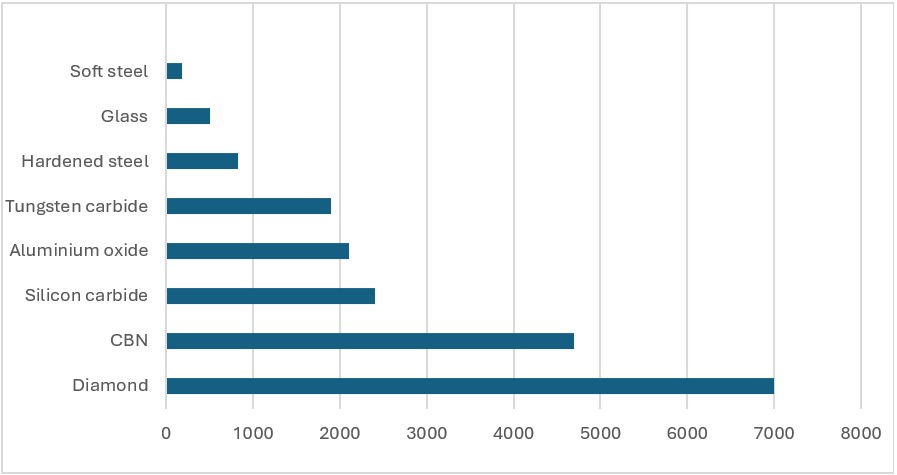
Below is a graph of the comparative hardnesses of a range of hard materials:
From Soft Steel to Cutting Tools
Industrial knife steels are generally cut and machined in a softer state before undergoing a hardening process. Once hardened, the blades are ground to their final dimensions and sharpened to produce a razor-sharp cutting edge.
Additional coatings can then be applied to improve wear resistance, corrosion resistance, or non-stick properties depending on the application.
At Renlaw, blades are hardened almost exclusively in a vacuum furnace to minimise warpage and the loss of surface integrity.
The blades are heated slowly to 1050-1200°C and subsequently quenched in Nitrogen to change the metallic structure and harden the steel. At this point the steel is very hard, but also brittle. Subsequent reheating to 300-500°C (tempering) toughens the structure of the steel and allows us to adjust the hardness and toughness of the steel to suit the application. In some cases, the finished blades are cryogenically treated by chilling them to -70°C to -260°C to further stabilise the metallic structure and improve the steels qualities.
Hardness of toolsteel, stainless steel and HSS is measured on the Rockwell “C” scale (HRc). To test this hardness, a diamond point is pressed into the surface of the hardened material with a predetermined force. The depth of penetration of this diamond point defines the hardness of the steel. ( a shallower indent = a harder steel).
Blades which are subject to higher impact forces, such as chipper blades or plastic shredder and granulator blades will typically have lower hardnesses and increase toughness, to prevent them from chipping and cracking. Blade operating on well-maintained machines with high-speed cutting processes would typically have higher hardnesses and better wear characteristics.
Learn more about your blade steels in the coming edition, where we look at the manufacturing process and the different grades of Tungsten Carbide
